
The Sierpinski Triangle "Chaos Game" Challenge - One Rotation
How to play the one rotation "Chaos Game" challenge. The game board below consists of a variation of the Sierpinski gasket using trapezoids drawn at level 2 [Construction Details]. One of the trapezoids is colored dark green; this is the Target. You also see a point colored red at one of the four vertices of the larger trapezoid border. This is the Seed. Your goal is to move the Seed into the interior of the Target in as few moves as possible. Each time you make a "move" in the game, this point will move to a new location in the game board. This becomes your current location. Both the Target and the Seed are chosen at random each time you start a new game.
There are three possible moves. When you click on button 2 or 3 , your current location moves half the distance to the corresponding lower left or lower right vertex. But when you click on button 1, you first move half the distance to the light green square and then rotate about the square by 180 degrees. That is, you flip around the square to the exact opposite side.
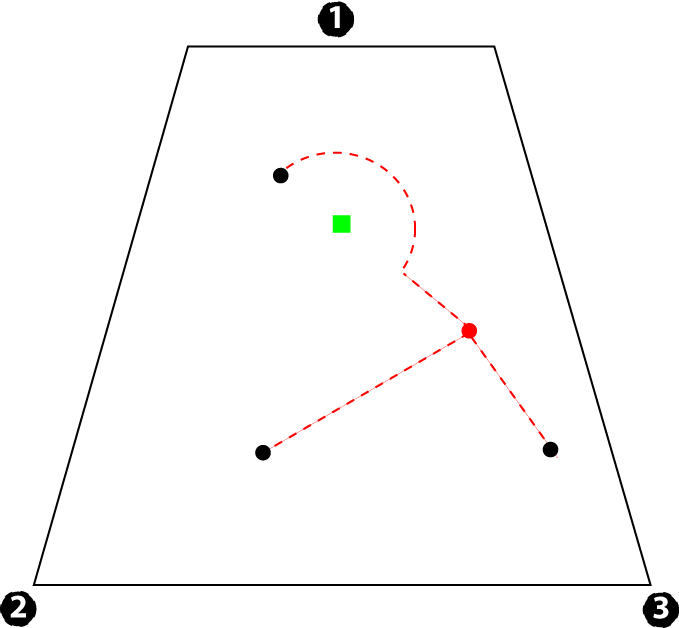
By a judicious choice of moves, you should be able to get your point into the interior of the Target in the minimum number of moves (3 or 4 depending on the initial point). This is indicated as the goal in the left sidebar. Your score (the number of moves you have made) is also recorded in the sidebar window. When you succeed in moving your current location into the interior of the Target, you receive a message telling you so.
More difficult Targets. If you select Medium (level 3), Hard (level 4), or Master (level 5) in the "Level" dropdown menu, the Target will be chosen at deeper levels of this modified Sierpinski gasket. The goal in the sidebar is adjusted accordingly.
Can you find an algorithm that will always move the Seed into the Target in the minimum number of moves, no matter the level? Give it a try!
| Other chaos game challenges involving rotations | |||
|---|---|---|---|
| 0 Rotations | 1 Rotation | 2 Rotations | 3 Rotations |
 |
|
 |
 |
| Play | Current Challenge |
Play | Play |
Credit: Based on the original Java game (1995) created by Bob Devaney and students at Boston University using an idea of Kevin Lee at St. Catherine University.