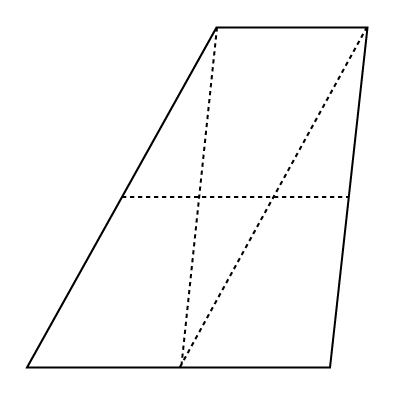
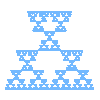
Trema Construction Details for One Rotation
For the trema construction for the Sierpinski gasket chaos game with one rotation, start with an isosceles trapezoid with the top edge $CD$ being half the length of the parallel bottom edge $AB$. The height can be whatever is desired. Subdivide the trapezoid into 6 regions by drawing line segments $ED$ and $EC$ from the midpoint of the bottom edge to the top vertices $D$ and $C$, and a horizontal line segment $FI$ between the midpoints of the side edges.
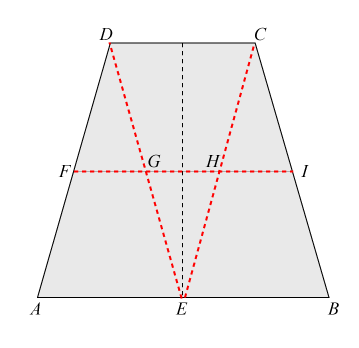
Because the opposite sides $AE$ and $DC$ are parallel and of equal length, $AECD$ is a parallelogram. For a similar reason, $EBCD$ is also a parallelogram. Therefore $EC$ and $AD$ are parallel, and $ED$ and $BC$ are also parallel.
Experiments
You can experiment with how the shape changes as the base length and height change. Click the base dot in the figure below and move it horizontally to change the base length, or click on the other dot and move it vertically to change the height.
The following video example uses an animated demonstration to show that the three smaller trapezoids are a scaled copy of the original isosceles trapezoid, with one of the copies rotated by 180°.
Proofs
We now show that the 3 trapezoidal regions will always be a copy of the original isosceles trapezoid scaled by 1/2 under the given constraint that the top edge is half the length of the parallel bottom edge, with one trapezoid rotated by 180°.
The image below shows the isosceles trapezoid and one of the trapezoidal regions in green. The table indicates how corresponding angles in the two trapezoids are equal using a transversal to two parallel lines.
| Trapezoid $AEGF$ (green) | Trapezoid $ABCD$ (gray) | Reason Equal |
|---|---|---|
| Angle $A$ | Angle $A$ | Same angles |
| Angle $E$ | Angle $B$ | $ED \parallel BC$ corresponding angles |
| Angle $F$ | Angle $D$ | $DC \parallel FI$ corresponding angles |
| Angle $G$ | Angle $C$ | $G = I$ since $ED \parallel BC$ $I = C$ since $DC \parallel FI$ corresponding angles |
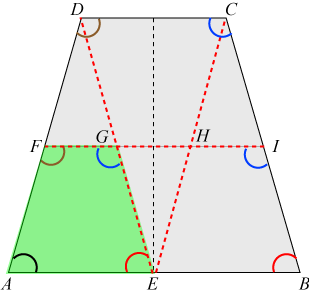
We have thus shown that the corresponding interior angles of trapezoid $ABCD$ and trapezoid $AEGF$ are the same. Moreover, ${|AE| = \frac12|AB|}$, $|AF| = \frac12|AD|$, $|FG| = \frac12|AE|= \frac12|DC|$, and $|GE| = |IB| = \frac12|BC|$. Therefore trapezoid $AEGF$ is a copy of trapezoid $ABCD$ scaled by 1/2.
The next image shows the green trapezoid region from above and another trapezoidal region in brown. The table indicates how corresponding angles in the two trapezoids are equal using a parallelogram and a transversal to two parallel lines.
| Trapezoid $AEGF$ (green) | Trapezoid $CDGH$ (brown) | Reason Equal |
|---|---|---|
| Angle $A$ | Angle $C$ | Opposite angles in parallelogram $AECD$ |
| Angle $E$ | Angle $D$ | $AE \parallel DC$ Alternate interior angles |
| Angle $G$ | Angle $G$ | Opposite angles |
| Angle $F$ | Angle $H$ | $AD \parallel EC$ Alternate interior angles |
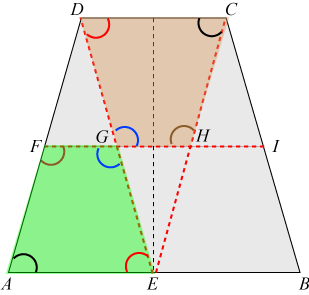
We have thus shown that the corresponding interior angles of trapezoid $AEGF$ and trapezoid $CDGH$ are the same. Moreover, the corresponding sides have the same length. Therefore trapezoid $CDGH$ is also a copy of trapezoid $ABCD$ scaled by 1/2 and rotated by 180°.
The next image shows the green trapezoid region from above and another trapezoidal region in yellow. The table indicates how angles in the two trapezoids are equal using corresponding angles for a transversal to two parallel lines.
| Trapezoid $AEGF$ (green) | Trapezoid $EBIH$ (yellow) | Reason Equal |
|---|---|---|
| Angle $A$ | Angle $E$ | $AD \parallel EC$ |
| Angle $E$ | Angle $B$ | $ED \parallel BC$ |
| Angle $G$ | Angle $I$ | $ED \parallel BC$ |
| Angle $F$ | Angle $H$ | $AD \parallel EC$ |
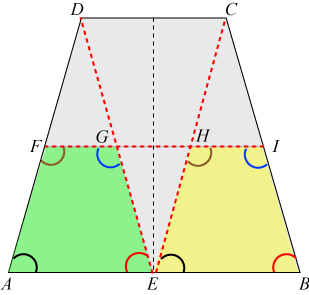
Hence the trapezoid $EBIH$ is congruent to trapezoid $AEGF$, and therefore trapezoid $EBIH$ is also a copy of trapezoid $ABCD$ scaled by 1/2.
The three isosceles triangles $\triangle DFG$, $\triangle CHI$, and $\triangle EGH$ are congruent since the interior angles are the same and ${|FG| = |GH| = |HI|}$.
Function
System
Position the initial isosceles trapezoid so that the base of width $2w$ is on the $x$-axis and the axis of symmetry is the $y$-axis.
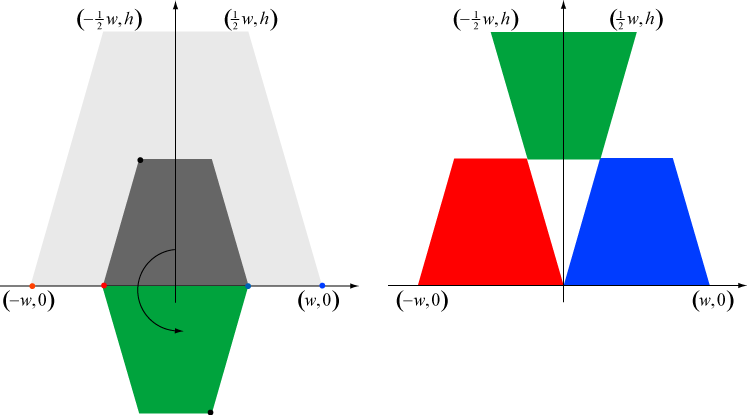
The dark gray trapezoid is the result of scaling the initial trapezoid by 1/2 (towards the origin). It is then rotated by 180° around the origin to form the green trapezoid, which then has to be translated up by $h$. The red trapezoid is the dark gray trapezoid translated by $w/2$ to the left, and the blue trapezoid is the dark gray one translated by $w/2$ to the right.
The following animation illustrates the affine transformations for the trema construction starting with the isosceles trapezoid.
The iterated function system for this orientation of the isosceles trapezoid is the following.
To find the fixed points, solve the following equations: $$ \begin{aligned} f_1:\quad \begin{bmatrix} x \\ y \end{bmatrix} &= \left[ {\begin{array}{cc} {-1/2} & 0 \\ 0 & {-1/2} \\ \end{array}} \right] \begin{bmatrix} x \\ y \end{bmatrix} + \begin{bmatrix} 0 \\ h \end{bmatrix} = \begin{bmatrix} -x/2 \\ -y/2+h \end{bmatrix} \quad \Rightarrow \quad F_1 = (0, \tfrac23 h) \\ \\ f_2:\quad\begin{bmatrix} x \\ y \end{bmatrix} &= \left[ {\begin{array}{cc} {1/2} & 0 \\ 0 & 1/2 \\ \end{array}} \right] \begin{bmatrix} x \\ y \end{bmatrix} + \begin{bmatrix} -w/2 \\ 0 \end{bmatrix} = \begin{bmatrix} x/2-w/2 \\ 0 \end{bmatrix} \quad \Rightarrow \quad F_2 = (-w, 0) \\ \\ f_3:\quad\begin{bmatrix} x \\ y \end{bmatrix} &= \left[ {\begin{array}{cc} {1/2} & 0 \\ 0 & 1/2 \\ \end{array}} \right] \begin{bmatrix} x \\ y \end{bmatrix} + \begin{bmatrix} w/2 \\ 0 \end{bmatrix} = \begin{bmatrix} x/2+w/2 \\ 0 \end{bmatrix} \quad \Rightarrow \quad F_3 = (w, 0) \end{aligned} $$
If the Sierpinski gasket chaos game with one rotation is played with the fixed points $(-A,0)$, $(A,0)$, and $(0,B)$, then the corresponding trema construction would use $w = A$ and $h = \tfrac32 B$.
General Case
Just as the Sierpinski gasket construction can be done with any triangle, not just an equilateral triangle, so, too, can the trema construction for one rotation be applied to any trapezoid for which the parallel sides have lengths in the ratio 2 to 1 [General Case Details]. An example of such a trapezoid is shown below, divided into the 6 regions by the trema construction. Click the buttons to display the fractal generated by iterating this construction. The black squares are the fixed points that would be used in the chaos game with one rotation.