

General Trema Construction with One Rotation
Suppose the fixed points are located at the points $F_1$, $F_2$, and $F_3$, where $F_2$ and $F_3$ are the fixed points for the rotation by 180° and $F_2F_3$ forms a horizontal segment. (Any set of three fixed points can be rotated to such an orientation.)
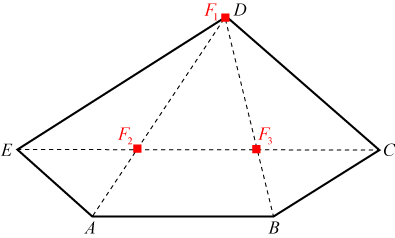
The functions corresponding to the chaos game moves for these fixed points are $$ \begin{aligned} f_1(P) &= P + \tfrac12(F_1-P) = \tfrac12P + \tfrac12F_1 \\ \\ f_2(P) &= P + \tfrac32(F_2-P) = -\tfrac12P + \tfrac32F_2 \\ \\ f_3(P) &= P + \tfrac32(F_3-P) = -\tfrac12P + \tfrac32F_3 \end{aligned} $$ Take $A = f_2(F_1)$, i.e. $F_1$ is moved halfway towards $F_2$, then rotated 180° around $F_2$, and take $B = f_3(F_1)$, i.e. $F_1$ is moved halfway towards $F_3$, then rotated 180° around $F_3$. Then $$ \begin{aligned} A &= f_2(F_1) = F_1 + \tfrac32(F_2-F_1) = -\tfrac12F_1 + \tfrac32F_2 \\ B &= f_3(F_1) = F_1 + \tfrac32(F_3-F_1) = -\tfrac12F_1 + \tfrac32F_3 \end{aligned} $$
Now consider what happens if the chaos game is played with points along line through $F_2$ and $F_3$ starting with $F_2$. Let $P_1 = F_2$ and let $P_2 = f_3(P_1)$ be the point when $P_1$ is moved halfway towards $F_3$ and rotated 180° around $F_3$. Continue constructing a sequence $P_n$ of points by alternating chaos game moves with $F_2$ and $F_3$, where $P_{2n} = f_3(P_{2n-1})$ and $P_{2n+1} = f_2(P_{2n})$ for $n \ge 1$. See the following diagram for the first 6 points.
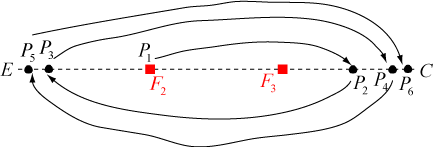
This gives $$ \begin{aligned} P_{2n} &= f_3(P_{2n-1}) = -\tfrac12P_{2n-1} + \tfrac32F_3 \\ \\ P_{2n+1} &= f_2(P_{2n}) = -\tfrac12P_{2n} + \tfrac32F_2 = \tfrac14P_{2n-1} - \tfrac34F_3 + \tfrac32F_2 \\ \\ P_{2n+2} &= f_3(P_{2n+1}) = -\tfrac12P_{2n+1} + \tfrac32F_3 = \tfrac14P_{2n} - \tfrac34F_2 + \tfrac32F_3 \end{aligned} $$ Define new sequences $L_n = P_{2n-1}$ and $R_n = P_{2n}$ for $n \ge 1$. Then from the result above we have $$ \begin{aligned} L_{n+1} &= \tfrac14L_n - \tfrac34F_3 + \tfrac32F_2, \quad L_1 = F_2 \\ \\ R_{n+1} &= \tfrac14R_n - \tfrac34F_2 + \tfrac32F_3, \quad R_1 = P_2 \end{aligned} $$
These are first-order linear recurrence relations whose solutions are $$ \begin{aligned} L_n &= 2F_2-F_3 + (F_3-F_2)\left(\frac14\right)^{n-1} \\ R_n &= 2F_3-F_2 - \frac12(F_3-F_2)\left(\frac14\right)^{n-1} \end{aligned} $$
Taking the limit of both sequences, we define $E$ and $C$ by $$ \begin{aligned} E &= \lim_{n \rightarrow \infty} L_n = 2F_2 - F_3 \\ C &= \lim_{n \rightarrow \infty} R_n = 2F_3 - F_2 \end{aligned} $$
Notice that $F_2$ and $F_3$ divide segment $EC$ into thirds since $|EC| = 3|F_3-F_2|$.
Combining the results for $A$, $B$, $C$, and $E$ shows that
$$
\begin{aligned}
\overrightarrow{AB} &= \frac32(F_3-F_2) \\
\overrightarrow{EC} &= 3(F_3-F_2)
\end{aligned}
$$
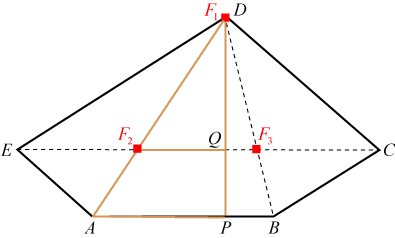
Therefore $AB$ and $EC$ are parallel and $|EC| = 2|AB|$. The points $ABCDE$ form a pentagon whose width is twice the length of the base. Moveover, the image below shows a perpendicular line from $D$ to the base. Triangles $\triangle DQF_2$ and $\triangle DPA$ are similar. Since $|DA| = 3|F_2A|$, it must also hold by similarity that $DP = 3|QP|$, i.e. the height of the pentagon is three times the distance from the base to the width.
The following GeoGebra app shows three such fixed points and the Pentagon formed by the calculations above. You can move the point $P$ around the fice edges of the pentagon, either manually by moving the point on the slider, or automatically by clicking on the Play button. As $P$ moves around the pentagon, the green points $f_1(P)$, red points $f_2(P)$, and blue points $f_3(P)$ will trace where these points would occur while playing the Sierpinski gasket chaos game with the point $P$.
Notice that as $P$ moves counterclockwise around the edges of the pentagon, the point $f_1(P)$ moves counterclockwise while points $f_2(P)$ and $f_3(P)$ move clockwise. The points trace out three copies of the pentagon each scaled by 1/2, with the red and blue pentagons rotated by 180°. Their boundaries form the lines used in the trema construction.
The following image summarizes the coordinates of the vertices of the pentagon in terms of the fixed points, as well as the trema construction for the pentagon. Points $F$ and $G$ are the midpoints points of edges $CD$ and $DE$, and $KL$ is a horizontal segment at half the height of the pentagon.
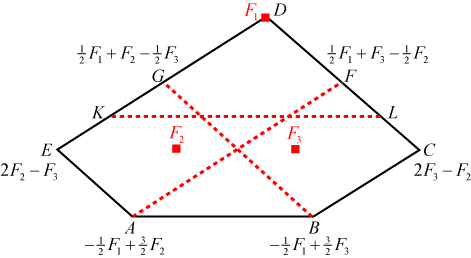
We can use these coordinates to show that $$ \begin{aligned} \overrightarrow{ED} &= F_1 -2F_2 + F_3 \\ \overrightarrow{AF} &= F_1 - 2F_2 + F_3 \\ \overrightarrow{BC} &=\tfrac12F_1 - F_2 + \tfrac12F_3 \end{aligned} $$ Therefore $ED$, $AF$, and $BC$ are parallel, and $|ED| =|AF| = 2|BC|$.
A similar calculation shows that $CD$, $BG$, and $AE$ are parallel, and $|CD| = |BG| = 2|AE|$. These observations are what were used in the proofs for the isosceles pentagon, and can be used here in the same way to show that the trema calculation for the pentagon divides the pentagon into three self-similar pieces scaled by 1/2 with two pieces rotated by 180°.
Use the following GeoGebra app to experiment with changing the locations of the three fixed points. As the points are moved, the three smaller pentagons will continue to maintain the self-similarity scaling of 1/2 determined by the three red dashed lines in the trema construction.