
Taylor series for \(f_\theta (r)\) near r = 0 (for side part of tree)
Recall that \(f_\theta (r) = x_m - x_k\) where $x_k$ is the x-coordinate of the branch tip for the path $R^k(LR)^\infty$ and $x_m$ is the x-coordinate of the branch tip for the path $R^m(LR)^\infty$, where $k$ is the smallest integer such that $k\theta ≥ 90^\circ$ and $m$ is the smallest integer such that $m\theta ≥ 45^\circ$. Note that $k ≥ 1$ and $m ≥ 3$. In fact, $m ≥ k+2$. For indeed, if $m = k+1$, then \[m\theta = (k+1)\theta = (k-1)\theta + 2\theta < 180^\circ + 2\theta < 90^\circ + 360^\circ = 450^\circ \] which is a contradiction. Also $k\theta < 270^\circ$ since \[ k\theta ≥ 270^\circ \Rightarrow (k-1)\theta = k\theta - \theta ≥ 270^\circ - \theta > 270^\circ - 180^\circ = 90^\circ \] which is again a contradiction.Let \(\alpha = e^{\theta i}\). The branch tip for $R^k(LR)^\infty$ occurs at the point corresponding to the complex number \[ z_k = \left(i+ir\alpha^{-1} + ir^2\alpha^{-2} + ir^3\alpha^{-3} \ldots + ir^k\alpha^{-k} \right)+ \left(ir^{k+1}\alpha^{-k+1} + ir^{k+2}\alpha^{-k} + \ldots\right). \] Then \[ \begin{align} x_k = -\text{Im}(z_k) &= 1 + r\sin(\theta) + r^2\sin(2\theta) + r^3\sin(3\theta) + \ldots + r^k\sin(k\theta) \\ \\ &\quad\quad+ r^{k+1}\sin((k-1)\theta) + r^{k+2}\sin(k\theta) + \ldots. \end{align} \] The value of $x_m$ is obtained in the same way to get \[ \begin{align} x_m = \text{Im}(z_k) &= 1 + r\sin(\theta) + r^2\sin(2\theta) + r^3\sin(3\theta) + \ldots + r^k\sin(k\theta) \\ \\ &\quad\quad+ r^{k+1}\sin((k+1)\theta) + r^{k+2}\sin((k+2)\theta)\\ \\ &\quad\quad+ \dots + r^m\sin(m\theta) + r^{m+1}\sin((m-1)\theta) + r^{m+2}\sin(m\theta) + \ldots. \end{align} \] Subtracting the two expressions for the x-coordinates shows that \[ \begin{align} f_\theta (r) &= r^{k+1}\left(\sin((k+1)\theta) - \sin((k-1)\theta)\right) + r^{k+2}\left(\sin((k+2)\theta) - \sin(k\theta)\right) + \ldots \\ \\ &= 2\sin(\theta)\cos(k\theta)r^{k+1} + \left(\sin((k+2)\theta) - \sin(k\theta)\right)r^{k+2} + \ldots. \end{align} \]
Suppose $k\theta > 90^\circ$. Since $90^\circ < k\theta < 270^\circ$ we have \(\cos(k\theta) < 0\) and \(\sin(\theta) > 0\), and so the coefficient of $r^{k+1}$ will be negative, and in particular, non-zero. Therefore \(f_\theta (r)\) will behave like the function \({2\sin(\theta)\cos(k\theta)}r^{k+1}\) when $r$ is close to 0.
If $k\theta = 90^\circ$, then the $r^{k+1}$ term in the formula for \(f_\theta (r)\) will cancel. Therefore the behavior of \(f_\theta (r)\) will be determined by the $r^{k+2}$ term when $r$ is small. Hence \(f_\theta (r)\) will behave like the function \[ \left(\sin((k+2)\theta) - \sin(k\theta)\right)r^{k+2} = \left(\cos(2\theta) - 1\right) r^{k+2} . \] Again the coefficient will be negative. It is important to note that because $m ≥ k+2$, no term involving a power of $r$ with exponent greater than or equal to $m+1$ will affect the $r^{k+1}$ or $r^{k+2}$ terms.
So in either case, when $r$ is close to 0, the function \(f_\theta (r)\) will behave like $Ar^n$ with $A < 0$. Thus the graph of \(f_\theta (r)\) will be decreasing and concave down for small values of $r$.
Examples
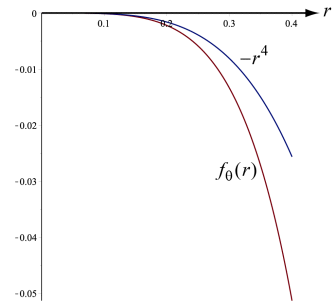
Asking about the behavior of a function near $r = 0$ is really asking about the Taylor series for the function centered at $r = 0$. A computer algebra system like Maple or Mathematica can calculate a Taylor series up to a given order.Example 1: $\theta$ = 80° (so $k$ = 2 and $m$ = 6, with $k\theta > 90^\circ$)
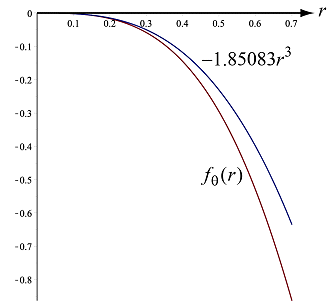
Example 2: $\theta$ = 45° (so $k$ = 2 and $m$ = 10, with $k\theta = 90^\circ$)