
Heighway Dragon Area Details
We consider the Heighway dragon as constructed using line segments starting with an initial segment of length 1. An IFS for this construction is given by the following.
where \(r = \frac{1}{{\sqrt 2 }}\). At each iteration, scale the current figure by \(r = \frac{1}{{\sqrt 2 }}\) and rotate by 45 around the origin. This is function \(f_1\). Then make a copy of this figure and rotate it by 90° around the point (1/2,1/2). This will give an equivalent result as the function \(f_2\).
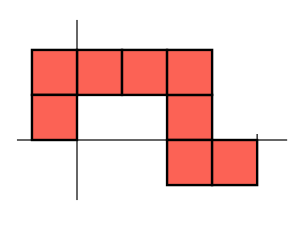
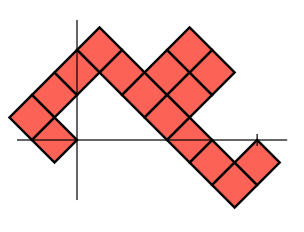
Starting with any compact set, iterations of that set using the two functions in this IFS will always converge to the Heighway dragon. We can start with a square \(S_0\) whose diagonal is the initial segment of length 1. let \(S_n\) denote the sequence of iterations of \(S_0\), i.e. \(S_{n+1} = f_1(S_n)+f_2(S_n)\). The sets \(S_n\) for \(n = 0,1,2,3,4\) are shown below.
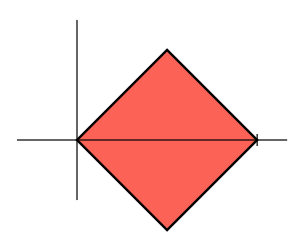
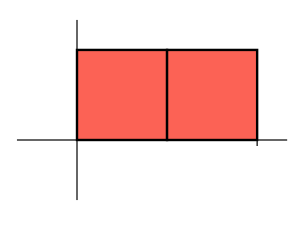
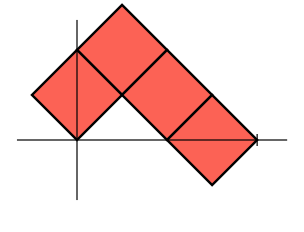
Each of these iterations can form a tile by rotating a copy of each by 90°, 180°, and 270° around the origin. The copies are disjoint up to measure 0, i.e. they do not overlap except along the boundaries. (We will always use "disjoint" to mean "disjoint up to measure 0".)
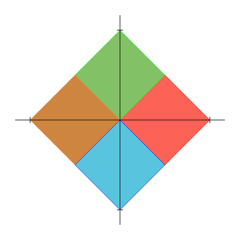
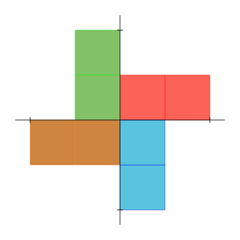
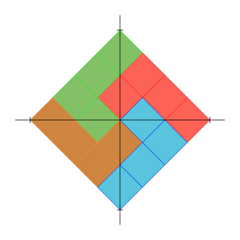
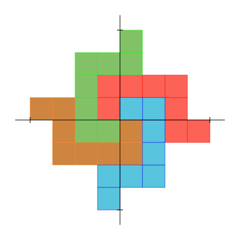
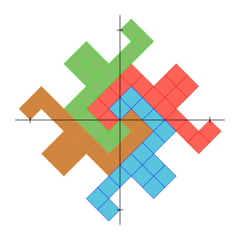
Let \(T_n\) be the tile formed this way from the set \(S_n\). Since the sets \(S_n\) converge to the Heighway dragon, the sets \(T_n\) converge in the Hausdorff metric to \(H_4\), four disjoint copies of the Heighway dragon rotated 0°, 90°, 180°, and 270° around the origin.
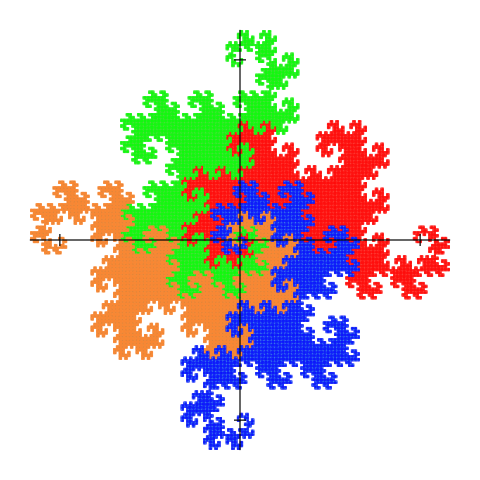
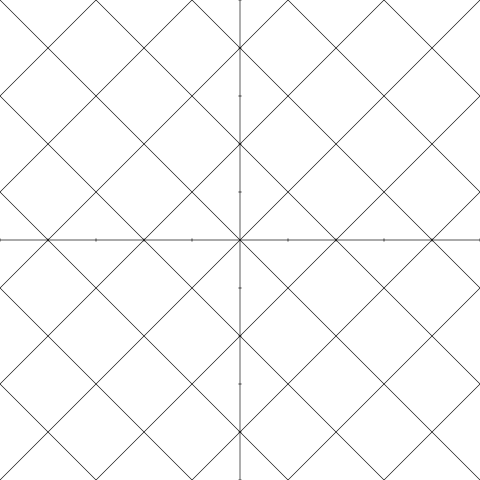
Each set \(T_n\) can form a lattice tiling of the plane using the lattice shown below that is formed by the vectors \(\mathbf{v_1} = (1,1)\) and \(\mathbf{v_2} = (1,-1)\). Let \(\Lambda = \{k_1\mathbf{v_1} + k_2\mathbf{v_2}: k_1, k_2 \in \mathbb{Z} \}\) be the corresponding lattice points. These form a discrete translation set for the tiling. This means that \(\Lambda\) is a subset of the plane such that for every bounded region of the plane, there are only finitely many points of \(\Lambda\) inside the region, and \[\bigcup_{\lambda \in \Lambda} (T_n + \lambda) = \mathbb{R}^2.\] This condition means that if we take every point \(\lambda \in \Lambda\) and shift \(T_n\) by that vector, the collection of all such translated copies covers the entire plane. In other words, every point of \(\mathbb{R}^2\) lies in a translate of \(T_n\).
Click on each of the buttons to the left to see a partial tiling for the first 9 iterations. At this size and resolution, you will not see much difference past \(n = 9\).
Since each of the sets \(T_n\) tiles the plane, and the sets \(T_n\) converge to the \(H_4\), the four copies of the Heighway dragon, then \(H_4\) will also tile the plane. Here's why.
Suppose \(z\) is a point in the plane. For every \(n\), there is a point \(\lambda_n\) in \(\Lambda\) such that \(z\) is in the set \(T_n + \lambda_n\). Now all the sets \(T_n\) and the point \(z\) lie inside a circle of a sufficiently large radius. This means that the collection \((\lambda_n)\) will lie in a bounded region. Since \(\Lambda\) is a discrete translation set, only a finite number of members of \(\Lambda\) are in that bounded region. Therefore there must be a subsequence \((\lambda_{n_k})\) all of whose terms are equal to a constant \(\lambda\). Now let \(\varepsilon > 0\). Since the sets \(T_{n_k}\) converge to \(H_4\) in the Hausdorff metric, there is an integer \(M\) such that \(T_{n_k} \subset N_\varepsilon(H_4)\) for all \(n_k \ge M\), where \(N_\varepsilon(H_4)\) is the \(\varepsilon\)-neighborhood of \(H_4\), i.e. all the points within a distance \(\varepsilon\) of \(H_4\). But then \(T_{n_k}+\lambda \subset N_\varepsilon(H_4+\lambda)\) for all \(n_k \ge M\). Therefore \(z \in N_\varepsilon(H_4+\lambda)\) for all \(\varepsilon > 0\), so we must actually have \(z \in H_4+\lambda\). Thus \(\displaystyle \bigcup_{\lambda \in \Lambda}(H_4+\lambda) = \mathbb{R}^2\).
We can now use the tiling of the plane to show that the area of \(T_n\) is the same as the area of \(H_4\) for all \(n\). Consider the identity \[\sum_{\lambda \in \Lambda}\chi_{\,_{T_n}}(z-\lambda) = 1\] where \(\chi_{\,_{T_n}}\) is the characteristic function for the set \(T_n\). \[\chi_{\,_{T_n}}(z) = \begin{cases} 1 \text{ if } z \in T_n\\ 0 \text{ if } z \notin T_n \end{cases}\] The identity expresses that each point \(z\) in the plane lies in exactly one translate of \(T_n\). The exception are the points on the boundary of \(T_n\), a set of measure 0. Let \(F\) be the parallelogram determined by the vectors \(v_1\) and \(v_2\) (sometimes referred to as the fundamental domain). Integrating the identity with respect to \(z\) over the set \(F\) gives \[\int_F \sum_{\lambda \in \Lambda} \chi_{\,_{T_n}}(z - \lambda) \, dz = \int_F 1 \, dz = \text{area}(F).\] On the left-hand side, since the sum only has one non-zero term, we may interchange the sum and the integral: \[\sum_{\lambda \in \Lambda} \int_F \chi_{\,_{T_n}}(z - \lambda) \, dz.\] Changing variables by setting \(w = z - \lambda\), we obtain \[\int_F \chi_{\,_{T_n}}(z - \lambda) \, dz = \int_{F+\lambda} \chi_{\,_{T_n}}(w) \, dw.\] Since the region \(F\) also tiles the plane with the same lattice, summing over all \(\lambda \in \Lambda\) gives \[\sum_{\lambda \in \Lambda} \int_{F+\lambda} \chi_{\,_{T_n}}(w) \, dw = \int_{\mathbb{R}^2} \chi_{\,_{T_n}}(w) \, dw = \text{area}(T_n).\] Therefore \(\text{area}(T_n) = \text{area}(F) = 2\) for all \(n\). Each \(T_n\) consists of four disjoint copies of the set \(S_n\), so \(\text{area}(S_n) = 2/4 = 1/2\).
Now the exact same integration can be done with the tile \(H_4\) and the identity \[\sum_{\lambda \in \Lambda}\chi_{_{H_4}}(z-\lambda) = 1\] to conclude that \(\text{area}(H_4) = \text{area}(F) = 2\). Since \(H_4\) consists of 4 disjoint copies of the Heighway dragon, this implies that the area of the Heighway dragon is 2/4 = 1/2.