Area is not Continuous in the Hausdorff Metric
For two non-empty compact subsets \( A, B \subset \mathbb{R}^2 \), the Hausdorff distance is defined as \[ D(A, B) = \max \left\{ \sup_{a \in A} \inf_{b \in B} d(a, b), \sup_{b \in B} \inf_{a \in A} d(b, a) \right\} \] where \(d(a,b)\) is the usual Euclidean distance between the points \(a\) and \(b\). Here \(\displaystyle \inf_{b \in B} d(a, b)\) is the shortest distance of \(a\) to all of the points in \(B\). Now do the same in the other direction and then take the maximum of both to get the Hausdorff distance of set \(A\) from set \(B\). This can be summarized as the maximum of the distances from any point in A to the nearest point in B, and the distances from any point in B to the nearest point in A.
We consider the space of compact sets in the plane \(\mathbb{R}^2\), equipped with the Hausdorff metric. Define the function \(f\) by \[ f(K) = \text{Area}(K), \] the Lebesgue measure (area) of the compact set \(K\). We will show that \(f\) is not continuous with respect to the Hausdorff metric.
Counterexample
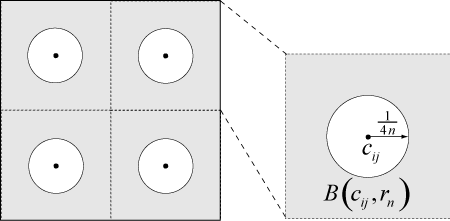
Let \(S = [0,1]^2\), which has area \(1\). For each integer \(n \geq 1\), divide \(S\) into an \(n \times n\) grid of equal small squares. Let \(c_{ij}\) denote the center of the \((i,j)\)-th square, where \(i,j = 1, \dots, n\). Define \[ K_n = [0,1]^2 \setminus \bigcup_{i,j=1}^n B(c_{ij}, r_n), \qquad r_n = \frac{1}{4n}, \] where \(B(c,r)\) denotes the open disk of radius \(r\) centered at \(c\). So \(K_n\) is what is left after the open disks \(B(c_{ij}, r_n)\) are removed from the square \(S\). Because an open set is removed from \(S\), each \(K_n\) is compact.
Here is an example with \(n=2\), where \(K_2\) is the gray region. The dots are the points \(c_{ij}\) and each white disk has radius 1/8.
Since the holes are disjoint disks of radius \(r_n\), any point of \(S\) lies within distance \(r_n\) of \(K_n\). Thus, \[ D(K_n, S) = r_n = \frac{1}{4n} \to 0. \] Therefore the sequence \(K_n\) converges to \(S\) in the Hausdorff metric.
The total area removed is the sum of the areas of the \(n^2\) disks: \[ \text{Area}(S \setminus K_n) = n^2 \cdot \pi r_n^2 = n^2 \cdot \pi \left( \frac{1}{4n} \right)^2 = \frac{\pi}{16}, \] independent of \(n\). Therefore, \[ \text{Area}(K_n) = \text{Area}(S) - \frac{\pi}{16} = 1 - \frac{\pi}{16}. \]
We have \(K_n \to S\) in the Hausdorff metric, but \[ f(K_n) \to 1 - \frac{\pi}{16} \neq f(S) = 1. \] Thus, \(f\) is not continuous.